Giving Oregon K-12 teachers tools for teaching computer science in the classroom
By Linda Barney, Barney, and Associates
The Oregon Computer Science Teachers Association (OregonCSTA) is an organization of teachers training teachers in Oregon since 1984. OCSTA’s focus is professional development in the areas of computer science and engineering education for K-12 educators and extended program volunteers. OCSTA held their 2026 Spring Teacher’s Conference on April 11 at George Fox University in Newberg, Oregon. The conference provided free professional development (PD) learning opportunities for teachers in Oregon teaching K-12 computer science classes. Outgoing OCSTA President, Terrel Smith welcomed conference attendees. In reflecting on the conference, Terrel said “The OCSTA Spring Conference was well attended considering all of the competing events and good weather. The presenters offered useful, and relevant information on challenging issues facing teachers and our K-12 education system.”
OCSTA Elects New President
OCSTA held annual elections during the 2026 Spring Conference and elected Jacob Niebergall as OCSTA President for 2026. Niebergall is a leader in teaching computer science and AI concepts to elementary school students. He received the TechStart Technology Teacher of the Year for grades K-8 in 2024 for his work teaching a sixth-grade course at Sunset School in Coos Bay, Oregon which introduced students to Science, Technology, Engineering, Art, and Mathematics (STEAM) including innovative computer science, artificial intelligence (AI), augmented reality (AR), and virtual reality (VR) concepts. He is also actively involved in working with ODE on CS and AI implementation plans. Niebergall is currently acting as a Teacher On Special Assignment (TOSA) focusing on enhancing the instructional systems in his building and district.
“I don’t think it’s controversial to say that families in Oregon want kids and teachers to responsibly and effectively interact with the newest generation of AI enhanced devices. To that end, OCSTA is on a collective journey to build-out and clarify Oregon’s CS systems to support those goals for learners, in collaboration with industry,” states Jacob Niebergall, President OCSTA.
Oregon Department of Education Computer Science Standards Keynote
To enhance computer science education in Oregon, the Oregon Department of Education (ODE) created a Computer Science Initiative which aims to provide CS standards in the state. Adrienne Pierce, ODE Well-Rounded, Integrated and Digital Learning Director, was the conference keynote speaker. Pierce discussed ODE’s new draft of the Computer Science Optional Standards covering CS education national alignment, computational thinking, and AI-readiness. During the session, Pierce covered current standards being drafted and encouraged educators to provide feedback on the CS standards. Click here to see an article summarizing the ODE CS Optional Standards sessions.
AI Conference Sessions
A major focus of the conference was on best practices for teaching artificial intelligence (AI) to K-12 students. The following conference sessions focused on using AI in K-12 classrooms.
AI Drivers for Educators: Issues & Ethics: In this session, Judson Birkel CS teacher at South Salem High School provided information for educators on how to build a safe AI culture for K-12 students. Birkel states, “Generative AI is no longer a futuristic concept; it's in your classroom today. Teachers are using it to plan lessons, students are using it for research, and districts are adopting AI-powered platforms at a record pace. But this rapid adoption has created a legal and ethical minefield for educators on the front lines. Dangers of AI include sycophancy, hallucinations, confirmation bias, algorithmic bias, and the fact that it’s a black box.” But AI guidelines to aid in appropriate AI training for K-12 education are being developed via the AI Warning And Resources for Education (AWARE) Act (HR 5360) which directs the Federal Trade Commission (FTC) to create educational materials for parents and educators regarding AI risks and privacy issues. The NSF AI Education Act of 2026 (S.3957) is in process, which would provide grants to undergraduate students for AI training.
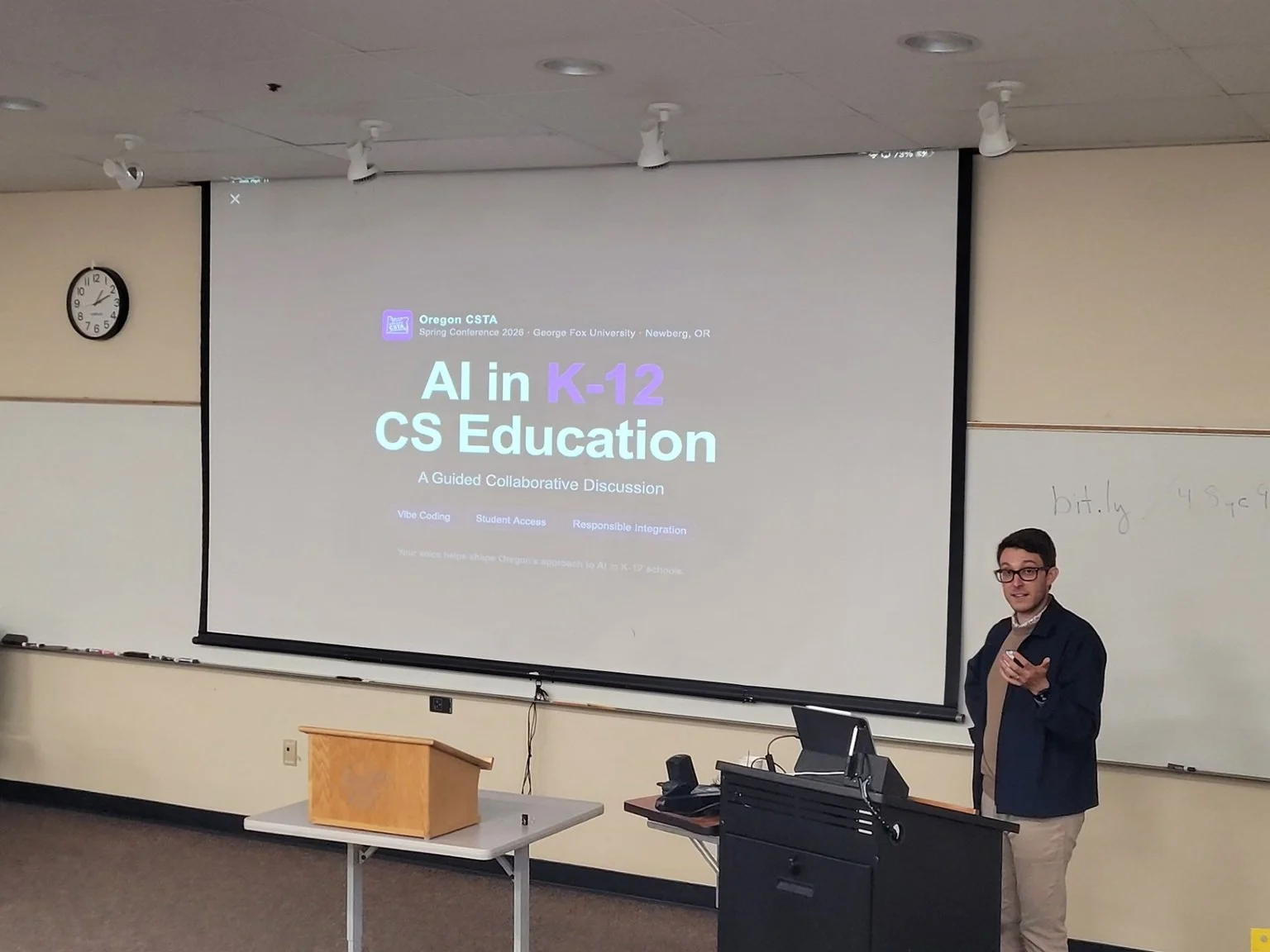
AI: Curriculum Design and Response: Jacob Niebergall led a session where attendees discussed how AI is changing everything in computer science. Topics discussed included vibe coding, student exposure to AI tools, and what responsible AI integration looks like in K-12 classrooms. The collaborative discussion will help determine what OCSTA should advocate for in computer science education at the state level.
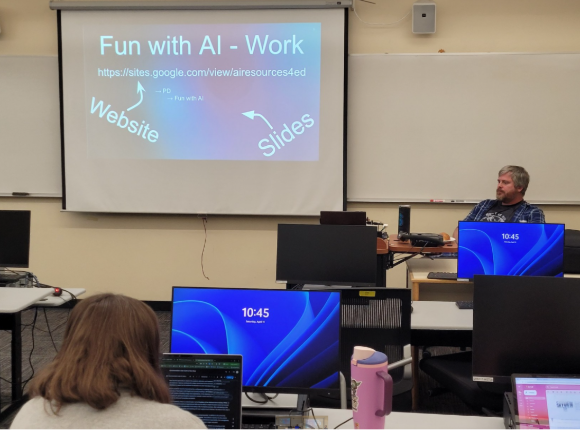
Fun with AI-Parts 1 and 2: Judson Birkel led two sessions designed to get attendees thinking about what they can do with AI. The Part 1 session focused on what teachers and students can do with AI. Examples included using AI to refine course materials, proofread email responses/requests, and create creative, engaging assignments or worksheets. Part 2 showed examples of how AI can be used outside the classroom to create videos, do vibe coding, and music generation.
Creating AI – Assignments and Software: Jason Galbraith described how his Sunset High School advanced consumer science class teaches students to create learning software, rather than just using it. The CS Pathway includes basic and advanced classes in computer systems, web design, programming logic, cybersecurity, C++ data structure, finite state machines, networks, game design/board games and robots/self-driving vehicles. Galbraith also uses the CodeHS units on AI, data science and statistics. The session covered AI classroom assignments, and software packages used including Python, and Jupyter notebooks with TensorFlow and Karas libraries.
High School Programming Competitions
Programming Contest Problems: Coding competitions can be difficult to plan and prepare. George Fox University (GFU) has been hosting a George Fox University High School Programming Competition both onsite at GFU and as a virtual challenge. The 2026 GFU High School Programming Competition was held as a virtual event. Brent Wilson, CS Chair at GFU, led the session presenting a set of programming contest problems that can be integrated into any high school curriculum.
Programming Competition Prep: Tips and Tricks:
In this session, Judson Birkel stated, “Let’s talk about a few tips and tricks I give my students when preparing for a coding competition. The session looked at a collection of past GFU coding competitions, to help see the pattern in all problems, and work towards simplifying the process. The language I’ll focus on is Python, but the concepts can be converted to other programming languages. A big focus will be on file reading and input receiving, parsing data, and building functions (divide and conquer).”
What Can STEM Hubs Do for You?
Julia Betts, Executive Director South Salem Metro STEM Partnership, presented the "State of the STEM Hubs" report. STEM Hubs are connectors and capacity builders with 13 Regional hubs across Oregon. The STEM Hubs function as backbone organizations connecting: K–12, higher education, industry, and community partners. The Hubs have system-level impact and stress equity and access across underserved communities. Hubs have these goals for the 2025-2027 Oregon Biennium:
Access and exposure (K-12): Provide 1) Early CS K-2 screenless coding and robotics, 2) elementary school integrations (CS + science/math), and 3) lending libraries to aid in removing cost barriers.
Educator support: Provide 1) AI + CS professional learning, 2) embedded coaching / co-teaching models, and 3) PLC integration + district-level support.
Pathways & Advanced Learning: Provide 1) Dual credit CS (e.g., CS161 partnerships), 2) peer-teaching models (HS through elementary), and 3) robotics, esports, fabrication, and industry-connected experiences.
Funding: Betts indicated that STEM Hubs are positioned relatively well with funding anticipated to be stable with full funding for this biennium since many hubs are just beginning to access 2025-2027 funds.
Makey Makey: Code-a-Key Backpack Project
This workshop led by Derek Runberg started with a brief introduction to Microsoft MakeCode. Runberg demonstrated using the Makey Makey Code-a-Key Backpack along with a BBC micro:bit to create a computer science and invention literacy super power.
Using ECS as an On-ramp to Computer Science
It can be difficult to bring new and especially under-represented students into CS programs. This session was led by Terry Alexander who teaches computer science and robotics at Hillsboro High School. Alexander provided information on how teachers can use the Exploring Computer Science (ECS) program. The ECS program is a year-long, research-based, high school intro-level computer science curriculum and teacher professional development program that focuses on broadening participation in computing to students who typically encounter barriers to CS courses.
Game Design with Unity
Two introductory classes for Sunset High School use Unity and video game creation. This session led by Jason Galbraith introduced the software, how to use it, and assignments that are covered in the class.
Cybersecurity Session
Teaching cybersecurity strategies is a critical part of K-12 computer science education. One of the advanced classes in the Sunset High School CS pathway covers topics in Cybersecurity. Jason Galbraith provided information on the cybersecurity course including Unix commands, reverse engineering with assembly language, digital forensics, and decryption techniques. Galbraith recommends “The Code Book” as a good reference source.
CAD and Rapid Prototyping
Clark Farrand led this attendee-driven roundtable discussion on all things “Engineering” at the high school level. The discussion covered information such as CAD packages, digital fabrication projects, rapid prototyping, and areas for design testing (Fab Labs, Makerspace, or Digital Woodshop). The session also focused on computer science classroom management and best practices, architecture curriculum, and building a Program of Study—whatever it takes to get a program off the ground, or to the next level.
TechStart Supports OCSTA Teachers Training Teachers
“OCSTA’s focus on training hundreds of teachers to teach K-12 computer science since 1984 is unprecedented. There is no doubt that they have positively moved the needle for Oregon’s teachers and thousands of students’ careers and continue to do so. The dedicated volunteers who make this happen are truly knights in shining armor. Thank you to all who participate in this worthy endeavor, we look forward to supporting you and to your continued success,” states John Tortorici, TechStart Chair of the Board.