Giving Oregon K-12 teachers tools for teaching computer science in the classroom
By Linda Barney, Barney, and Associates
OCSTA Spring 2026 Conference Keynote: Oregon Department of Education Computer Science Standards & Educators Feedback
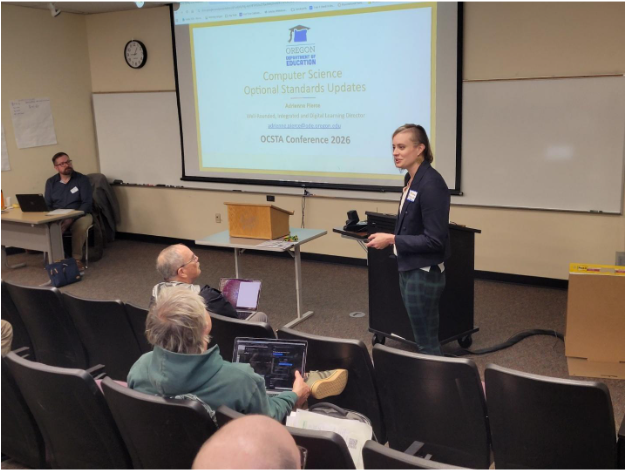
The Oregon Computer Science Teachers Association (OregonCSTA) is an organization of teachers training teachers in Oregon since 1984. OCSTA’s focus is professional development in the areas of computer science and engineering education for K-12 educators and extended program volunteers. OCSTA held their 2026 Spring Teacher’s Conference on April 11 at George Fox University in Newberg, Oregon. Adrienne Pierce, the Oregon Department of Education (ODE) Well-Rounded, Integrated and Digital Learning Director, opened the conference with a keynote speech about Computer Science Standards to be adopted in Oregon.
There is an expected shortfall in Oregon K-12 funding for Oregon schools. In 2025, the Oregon legislature declined to fund Senate Bill 541, which requires school district boards to ensure all schools offer Computer Science (CS) education in all grades. To enhance computer science education in Oregon, the Oregon Department of Education (ODE) created a Computer Science Initiative which aims to provide CS standards in the state.
During her keynote speech, Pierce introduced Nate Shelley, as a new ODE Digital Learning & Literacy Education Specialist. Pierce discussed ODE’s new draft of the Computer Science Optional Standards covering CS education national alignment, computational thinking, and AI-readiness. ODE is focusing on concurrent efforts with the National Computer Science Teachers Association (CSTA) standards effort. The CSTA National Standards are due for release in summer, 2026.
The ODE Computer Science Statewide Implementation Plan also focuses on these areas:
STEM Hub Innovation Grants: Prioritized to expand K–12 access, regional hubs, and professional learning
STEM Education Plan: CS emphasis embedded in draft goals (targeted for August 2026)
Foundational CS & AI Literacy: Core CS and computational thinking skills support responsible AI use
Elementary CS Research: AIR partnership examining K–5 implementation, pathways, and access barriers
Collaboration: Partnering with the Oregon Higher Education Coordinating Commission (HECC), the Oregon Regional STEM Hub Network, Expanding Computing Education Pathways (ECEP), nonprofits and industry to advance teacher capacity and alignment
ODE Welcomes Educator Feedback on Computer Science Standards
ODE solicited feedback on the first round of the Computer Science Standards and has revised the standards document based on feedback from educators. Click this link to view the first round of CS Standards.
Submit Suggestions to Draft 2 of the CS Standards
ODE is collecting feedback on Round 2 of the document beginning in April 2026. Pierce encourages educators to provide feedback on version 2.0 of the ODE draft optional computer science standards through July 2026. Click this link to launch the Spring 2026: Optional CS Standards Update Survey where you can make suggestions to the Standards document.
Goal Final Publication of Optional CS Standards
The ODE goal is to publish the final Computer Science Optional Standards in the winter of 2026/2027.
New OCSTA President Leads Session on Providing Feedback to DOE
OCSTA held annual elections during the 2026 Spring Conference and elected Jacob Niebergall as OCSTA President for 2026. Jacob Niebergall is a leader in teaching computer science and AI concepts to elementary school students. He received the TechStart Technology Teacher of the Year for grades K-8 in 2024 for his work teaching a sixth-grade course at Sunset School in Coos Bay, Oregon which introduced students to Science, Technology, Engineering, Art, and Mathematics (STEAM) including innovative computer science, artificial intelligence (AI), augmented reality (AR), and virtual reality (VR) concepts. Niebergall is currently acting as a Teacher On Special Assignment (TOSA) focusing on enhancing the literacy systems in his building and district. He is also actively involved in working with ODE on CS and AI implementation plans.
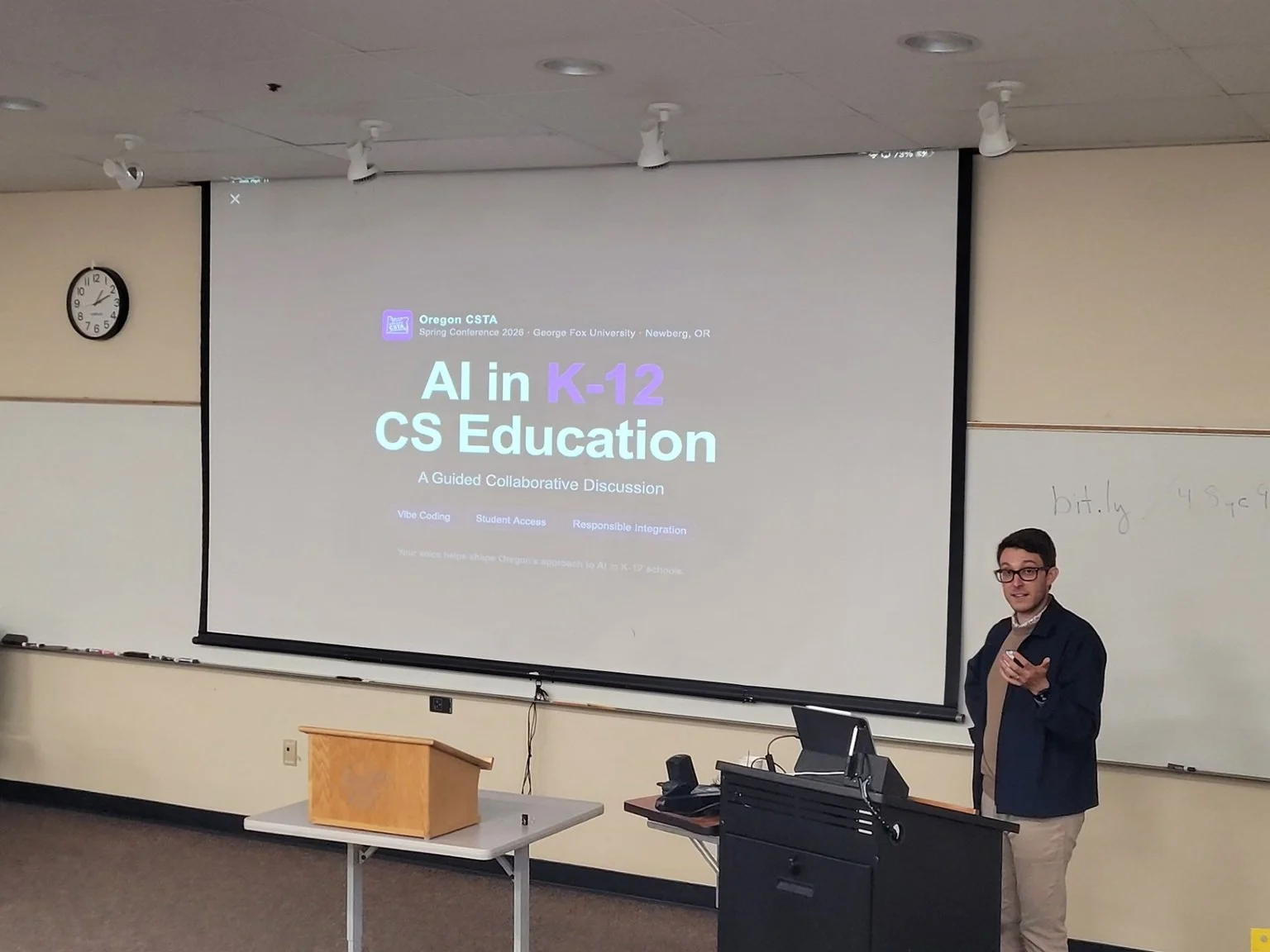
Jacob Niebergall led a session where attendees discussed how AI is changing everything in computer science. Topics discussed included vibe coding, student exposure to AI tools, and what responsible AI integration looks like in K-12 classrooms. The collaborative discussion will help determine what OCSTA should advocate for in computer science education at the state level.
Computer Science Legislation in the Next Biennium
Andrew Cronk, a computer science teacher at Southridge High School in Beaverton, Oregon led a review of the key points from this biennium's SB541 and a discussion of priorities to recommend for a future bill.