Empowering Educators: Guiding and Equipping K-12 Learners in Computer Science, AI, and Engineering
Linda Barney, Barney and Associates
The Oregon Computer Science Teachers Association (OregonCSTA) is an organization of teachers training teachers with a primary focus on providing professional development in the areas of Computer Science (CS) and engineering education for K-12 educators and extended program volunteers. The OCSTA 2026 Fall Conference included two conference summits held on October 9, 2026. The AI Summit focusing on Artificial Intelligence (AI) and Computer Science (CS) sessions was held at the Oregon Tech Wilsonville Campus. Sunset High School in Beaverton, Oregon hosted the Engineering Summit.
AI Summit and Forum
The AI Summit featured guests from the Oregon Department of Education (ODE), tech industry professionals, college professors, as well as K-12 organizations and educators with a focus on CS standards, AI policy, equity, teacher support, statewide K-12 CS education coordination, and possible future K-12 CS legislation. OCSTA President, Jacob Niebergall, a Teacher On Special Assignment (TOSA) focusing on enhancing the literacy systems in the Coos Bay, Oregon school district, led the opening session. He posed questions to three panelists including Nate Shelley (Digital Literacy Education Specialist, ODE), Julia Betts – Executive Director, South Metro-Salem STEM Hub, and Judson Birkel, CS teacher at South Salem High School.
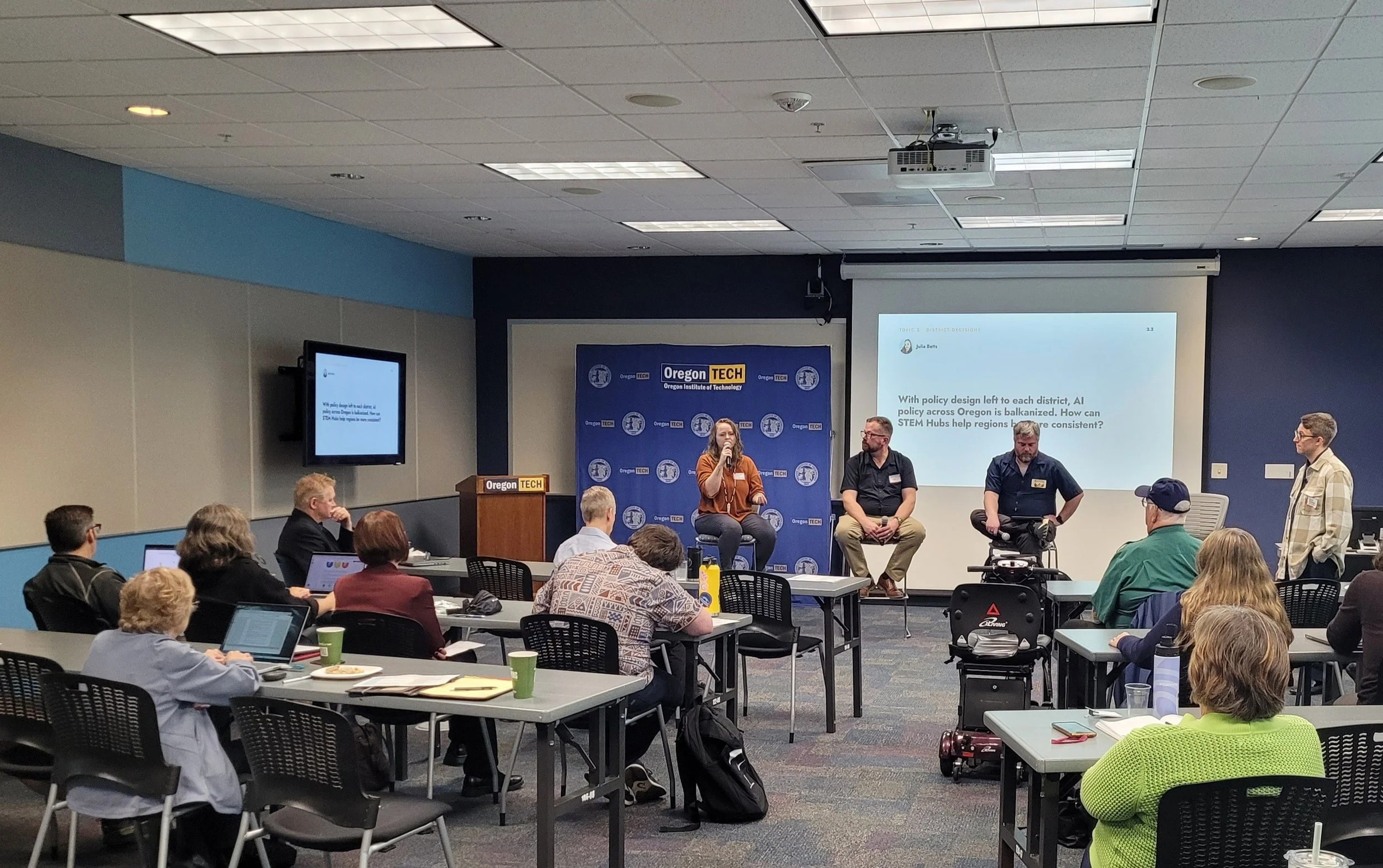
Speakers (L to R): Julia Betts, Nate Shelley, Judson Birkel, and Jacob Niebergall.
In Oregon, each Oregon school district must determine its own K-12 AI and CS education policy. There is a difference in the support level for AI training. Some Portland area school districts have dedicated positions to support AI teaching while others need help in determining how to implement an AI policy. Shelley indicated that ODE recently supported the adoption and alignment with national CSTA standards to teach CS and AI to K-12 students in Oregon schools. The ODE CS K-12 focus is on district CS and AI policies, teacher training, literacy, privacy safeguards, and approved AI tools. Areas of interest for ODE include: 1) providing equity in CS courses, 2) expanding CS access for girls and students of color, 3) reducing bias in AI tools, and 4) meeting federal security requirements for K-12 CS education. Shelley indicates ODE is doing outreach to determine how to support the classroom teachers in implementing the national CSTA standards in their classrooms.
Julia Betts indicates that STEM Hubs connect ODE, higher education, and industry. STEM Hub leaders emphasize CS and AI grassroots participation, collaboration among districts, and shared CS-AI expertise as well as buy-ins across school districts. It is critical that STEM Hubs understand the gaps in Oregon CS education to help target investment. STEM Hubs advocate for equitable access to quality CS education statewide. “We want standards that we can reference to support K-12 CS education across areas and using a standard K-12 policy helps meet this need,” states Betts.
Justin Birkel believes that AI is a societal issue, not only a CS issue, and that AI policies should remain flexible as technology changes. CS standards are important because they map instruction and learning outcomes which aids in the quality of student education. School districts need to understand laws about student privacy when setting up their CS - AI policies. It is critical that school districts meet Federal FERPA, COPPA, CIPA, OSIPA laws when deciding how to choose and use AI tools in their classrooms. Click here to see the TechStart OCSTA 2026 SuperQuest AI article that provides information on AI policy implementation and these laws.
Jacob Niebergall stresses that small school districts have different needs in implementing CS and AI than in larger districts. He indicates that ODE and STEM Hubs need to identify the special needs of the smaller districts and provide the needed support to provide quality CS and AI education.
National CSTA Standards and Resources Session
There are a variety of tools that can be used to teach computer science and AI in K-12 classrooms. In the National Computer Science Teachers Association (CSTA) Standards and Resources session, CS Teacher at Bend, Oregon High School and CSTA Regional Director Sean Glanz, provided information on the newly adopted CSTA Computer Science Standard as well as AI teaching and learning resources available to all educators from the national CSTA. The Foundational PK–12 Computer Science Standards are designed to prepare every student for a world powered by computing. The five concepts used in the standards are: 1) Algorithms & Design, 2) Programming, 3) Data & Analysis, 4) Systems & Security, and 5) Computing & Society. Artificial intelligence was identified as a priority during the standards revision process. AI-related content is distributed across the five concepts instead of being a discrete concept. Twelve K-12 CS practices are organized into four categories: 1) Ethics & Social Responsibility, 2) Inclusive Collaboration, 3) Computational Thinking, and 4) Human-Centered Design. Twelve practices are organized into four categories: (1) Ethics & Social Responsibility, (2) Inclusive Collaboration, (3) Computational Thinking, and (4) Human-Centered Design. The 2026 CSTA PK-12 Standards consist of 331 standards designed to guide computer science education across various grade levels. Click here to view the standards.
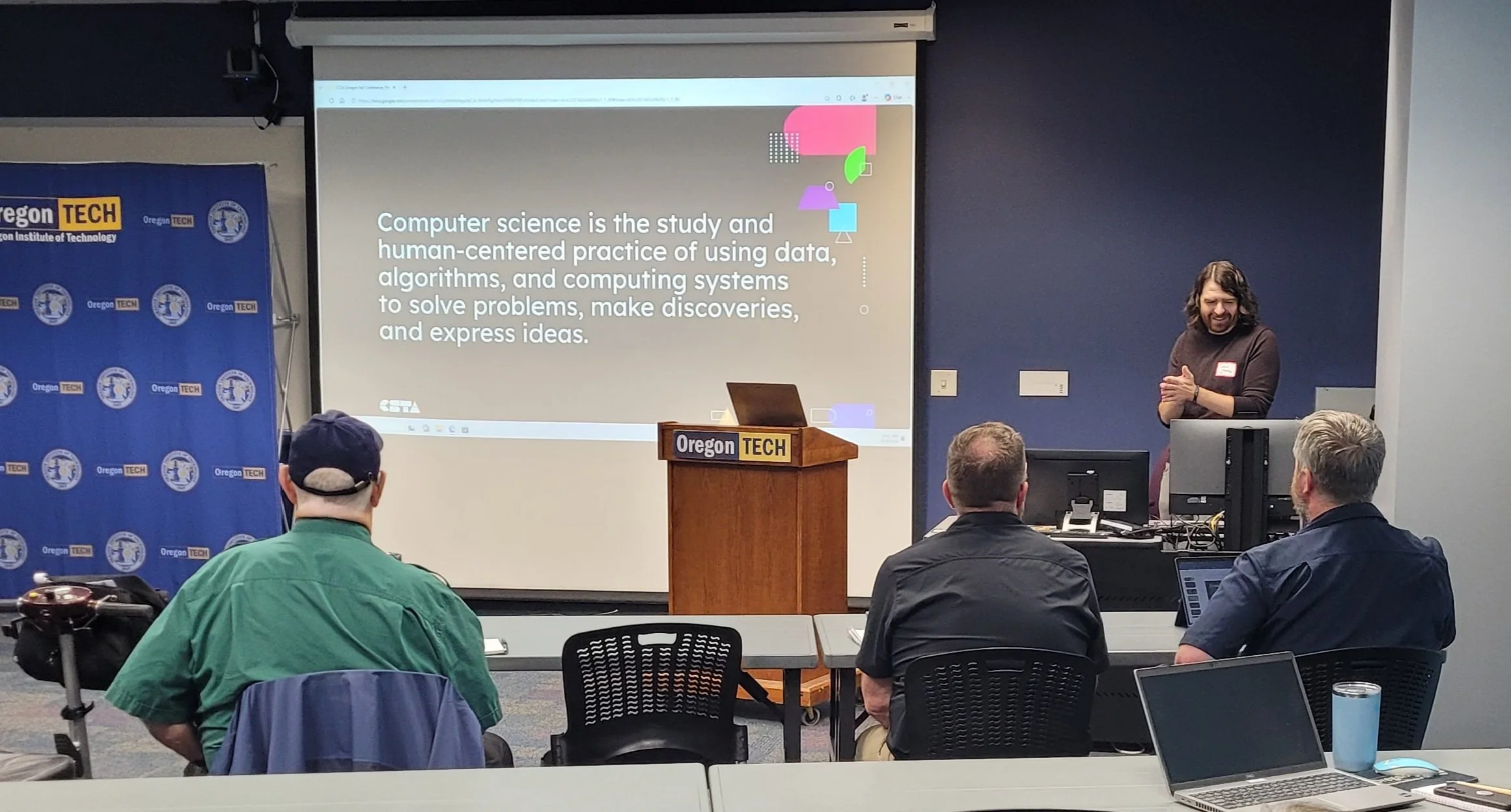
Stan Glanz National CSTA Regional Director presenting during the CSTA session
Using CS and AI in K-12 Computer Science Education Sessions
The All Things Exploring Computer Science (ECS) session was open to all high school teachers. Theresa Alexander, CS teacher at Hillsboro High School, discussed CS best practices, hard things like how to fit the curriculum in a semester, and how to grow a CS program. During the discussion, teachers shared ideas and provided tips on what worked in their CS programs.
In the CodeHS When All Else Seems Blocked session, Chris Winikka, Century High School CS teacher explored the current state of CS teaching in Oregon. There are various student privacy issues and Winikka indicated that teachers need to know what devices are used in their computer labs. Teachers also need to be aware of websites, software, and AI tools that school IT departments have blocked to protect student privacy. Teachers can pivot and thrive using the free tier CodeHS tools when their usual computer science tools are inaccessible. Topics included using CodeHS as a robust browser-based backup when platforms such as VS Code or GitHub are blocked. The session covered classroom-tested examples of how to leverage and extend CodeHS in authentic instructional settings. The session also provided ideas for adding courses, reusing courses, and other handy classroom techniques.
In the All Tools and Tricks for the Classroom and Beyond session, Judson Birkel focused on how teachers can use AI to educate kids and help automate teaching tasks. He described a framework for educational AI policies that includes Federal and State law requirements, school district and school-level AI policies, as well as how teachers need to develop their classroom AI policy on AI tools and ethical considerations used in teaching their students. He discussed what AI knowledge and skills kids should have and encouraged teachers to use this AI framework: 1) initiate and explore AI tools, 2) create and co-partner to explore practical uses of AI, 3) integrate and create a custom AI agent to automate tasks such as building lesson plans, course content and schedules. He provided links to AI literacy and laws that teachers need to understand.
Jacob Niebergall led the AI Sandbox session where attendees described how they use AI tools in their classrooms and for personal use. Attendees agreed that teachers need to be familiar with using AI tools and understanding which tools they are allowed to use by their school districts, how they integrate AI into assignments for students, and the importance of not exposing student information to AI in educational settings.
Strategies for Funding CS K-12 Education in Oregon
Peter Steinfeld, TechStart Executive Director, led a discussion about the importance of getting a K-12 computer science curriculum bill approved in the Oregon legislature for 2027 since Oregon SB541 did not pass in 2025 for various reasons including that it was presented as an unfunded mandate. Research conducted by Steinfeld found that technology drives the national economy with 92% of GDP is due to tech and data centers.
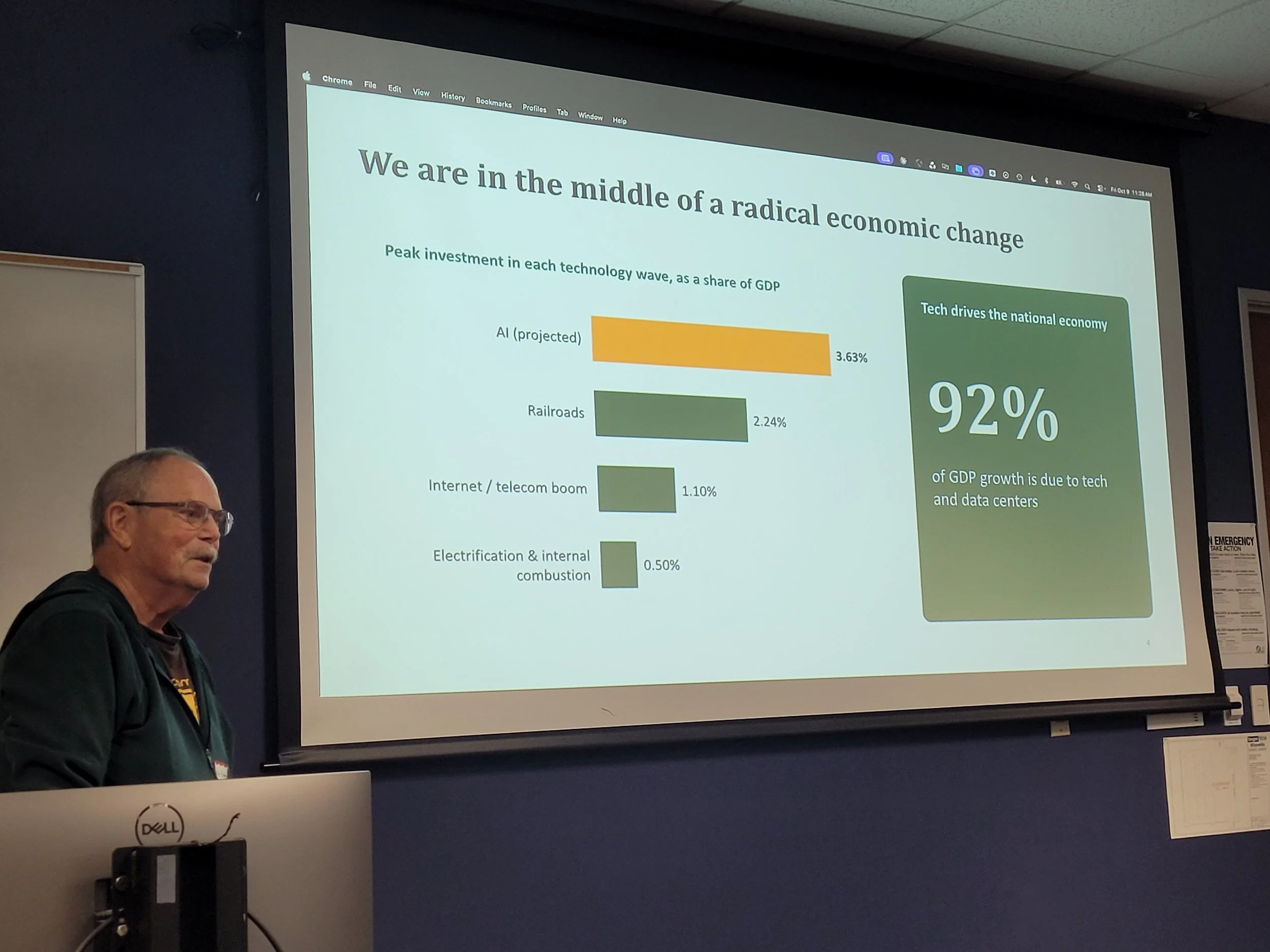
Peter Steinfeld described the need for CS K-12 legislative funding during his session.
Steinfeld states, “The goal of Oregon’s CS education plan is to make sure that all K-12 students have access to CS education as well as to provide computational literacy for all and for job training.” During his session, Steinfeld described some proposed provisions of a new K-12 CS bill which suggests training existing teachers on CS concepts, along with funding an ODE specialist to guide the implementation of the Oregon plan for CS education. Steinfeld described next steps for the bill as 1) Obtaining a legislative sponsor, 2) refining a draft bill, 3) getting industry backers, 4) getting support from parents and students, and 5) avoiding opposition. Various groups are reviewing and working on wording for a new legislative bill. Audience members provided feedback on the bill and are actively involved in reviewing and scripting text for a new bill. Click here to see a TechStart blog article about the proposed legislative funding bill.
TechStart Provides Support for CS Teachers and Students
TechStart is an Oregon-based 501(c)3 non-profit created by Oregon technology leaders with the goal of expanding access to computer science education for K-12 students in Oregon and SW Washington. During the lunch break, Peter Steinfeld, TechStart Executive Director, described the TechStart Teacher of the Year program that annually awards three outstanding K-12 Oregon and SW Washington teachers with a cash award of $1,000 for their classroom to spend on tech education materials including hardware, software, services, or curriculum. TechStart also donates a Student of the Year $2,000 scholarship award to two high schools juniors and seniors which can be applied to educational expenses and associated costs. Awards will be presented at the Technology Association of Oregon’s (TAO) Annual Tech Awards held annually in May. A TechStart Student Showcase is also part of the TAO event with high schools teams showing their projects in CS and engineering. TechStart and OCSTA will be publishing information on how teachers and students can apply for the awards or participate in the Student Showcase in future blog or newsletter articles.
John Tortorici, TechStart President, described a new Classroom to Career program being launched by TechStart and ProFocus Technology. As part of the program, tech leaders will visit classrooms, sharing their career story and path from high school to where they are today, plus answer student questions. Volunteering will be easy in terms of time required with no heavy preparations. The benefits for students can be great and have a high impact in helping young people see a path into tech careers. Click here for more information on the program and how industry individuals can complete forms to volunteer for the program.
The Engineering Forum
The Engineering part of the OCSTA Fall Conference was held at Sunset High School. Speakers at the event included Cady Geer, CS and Engineering teacher at Sunset High School and Clark Farand, Sherwood High School Engineering teacher. The Sunset High School CS and Engineering department put on a stellar event. Various presentations and tours helped the participants see the outstanding opportunities Sunset students enjoy as well as inspiring attendees for what they might glean to take back to their classrooms.
Don Domes, former CS and engineering teacher at Hillsboro High School and TechStart Board member states, “When students take an engineering class, they expect hands-on projects and Sunset is a treasure trove of examples and ideas. One space, about half the size of a regular classroom, was full of 3D printers, laser cutters, vinyl cutters, a water jet and other equipment. Engineering teachers were able to see the Sunset lab organization, software training tools, how to handle supplies and parts as well as attend event session focusing on the best tools and teaching methods.”
Engineering Sessions
Cady Geer, Sunset High School CS and Engineering teacher, led the Bringing Circuits and Code Together with Arduino and TinkerCAD Circuits session. Arduino is an open-source electronics platform and TinkerCAD Circuits is a free online simulation platform owned by Autodesk which is famous for 3D modeling. The tool runs in a browser and offers applications for circuits, coding, physics simulation and lessons. The tool was approved for student use by the Beaverton School District that signed a COPPA agreement. Geer demonstrated the TinkerCAD online circuit simulation platform that can simulate basic circuits or more complex ones. It contains a parts library and can add in coding with a simulated Arduino board or Micro:bit. It provides code in blocks or text, has some library support and can be exported to other programs. She showed various examples of how she might use the tool in a high school classroom including making a basic circuit, controlling a light, and powering a DC motor.
Clark Farrand, Sherwood High School Engineering teacher, led the Architecture & Rapid Prototyping in the Classroom, Part A & B sessions. This was a structured, but attendee-driven information session on classroom instruction on CAD, digital fabrication, architecture curriculum and other engineering topics such as vinyl plotting, laser cutting, 3D printing, and CNC milling. Farrand reports that his CAD classes also qualify for PCC dual credits. The presentation also included information on classroom management, and community resources including the PCC MakerSpace tool that teachers can use in their classroom instruction.
The Introduction to Computer-Aided Design (CAD) using Onshape session was led by Paul Snape, a teacher at the Cascade Academy in Bend, Oregon.
Cady Geer led the Robotics After Lego session. Robotics are popular with students and provide skills in programming and iterative design and give students experience with collaboration. Oregon previously used the LEGO FIRST Robotics program to train middle and high school students in LEGO robotics. However, the LEGO company is discontinuing this program for next year. Attendees discussed options, ideas, and ways to chart a path forward for the grades 6-12 robotics program.
During the lunch break, Cady Geer led the Engineering Potluck session where attendees brought one idea to share such as a lesson, project, machine recommendation, sub day activity, contact, or other topic. Attendees were able to leave with ideas from everyone else to better improve their engineering classes.
Engineering Forum Sessions Were Popular
In Oregon's siloed school systems technology teachers often have no one else that teaches their courses to collaborate with at their local sites. The Engineering Forum was a popular and well attended event. “The richness of providing practitioners the opportunity to cross pollinate with other professionals in the same field is invaluable. There were a lot of contact information exchanges going on,” according to Domes. Randy Macdonald, a CS teacher at Corvallis High School and former OCSTA leader states, “Even in just a half day of two one hours sessions followed by a lunchtime recap, I came away energized with a lot of new ideas to improve my classes.”